Baseball and softball team management
A baseball team management app that knows what a lineup card is
A travel baseball season is two practices a week, a Saturday doubleheader forty minutes away on a field nobody has played before, and a tournament where the pool schedule comes out on Wednesday night. In between, somebody keeps the book, somebody counts pitches, and the coach rewrites the batting order on the back of a receipt. leaguify puts the schedule, the card, the stats and the weekend’s logistics on one team page that families open on their phones.
Most team apps treat every sport as a list of names. This one was taught baseball: nine positions and a batting order that can be longer than nine, innings pitched written the way a scorebook writes them, and an earned run average that knows a twelve-year-old’s game is six innings long.
The batting order and the field, as two separate decisions
The lineup editor is a lineup card. Put the batting order in on one side and assign the nine field positions on the other. They are kept apart on purpose, because in youth baseball they are different lists: many leagues bat the whole roster, so the order can run to eleven or thirteen while only nine take the field.
The team page works out the rest. Each batter is shown with the position they are playing. A batter with no spot in the field is marked as the designated hitter or an extra hitter, whichever the card makes them, and a pitcher who is not hitting is listed beneath the order. Families see a first name, a last initial and a jersey number. Change the card on Friday night and the page has the new one before anyone asks who is catching.
A box score for each game, and season stats that follow from it
After a game, enter the final and a line for everyone who played: at-bats, runs, hits, RBI, walks, strikeouts and stolen bases, and for whoever pitched, innings, hits, earned runs, walks and strikeouts. Innings go in the way the book has them, so 4.2 means four and two thirds.
Season totals are added up from those games every time the page loads, so there is no second set of numbers to keep in step. Batting average, ERA and WHIP are worked out for you. ERA is scaled to a six-inning game by default, and you can change that if your league plays seven. A player who has not had an at-bat shows no average at all, which is kinder than .000.
Your record updates with each final, and it shows a tie only once you have had one. If your league keeps standings on its own site, add the link and it sits under your results.
Which park, which field, and when to be there
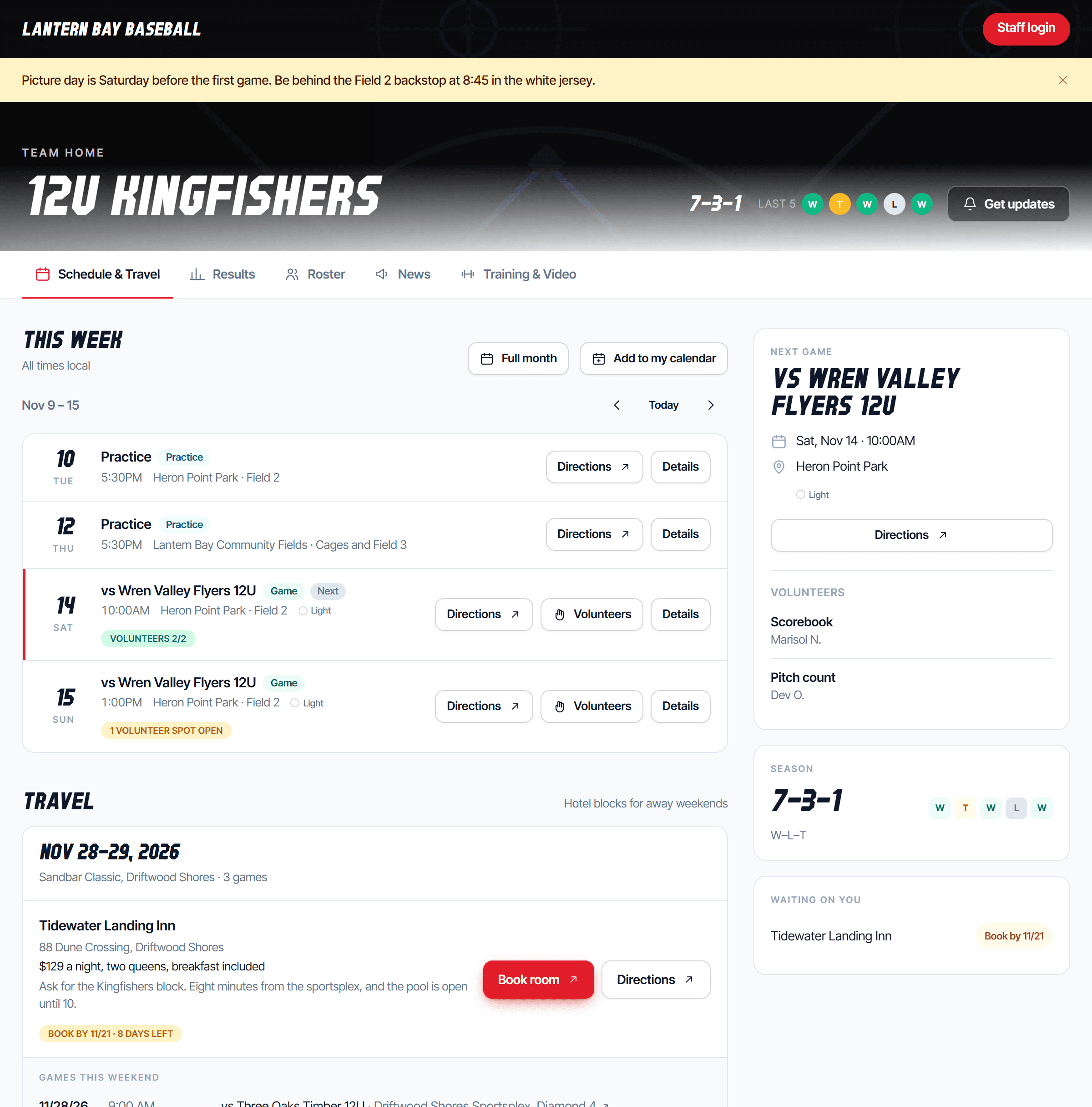
Every game and practice carries the park’s name, its address and a directions button. Complexes with six diamonds get a line for which one, so "Field 4" is on the event instead of in a text sent from the parking lot. Set how early players should arrive and the page does the arithmetic, and keeps doing it if the game time moves.
Light jerseys at home and dark on the road is the default, and you can change it for the one tournament that assigns colors. Families who subscribe to the team calendar see each change on their own phones. If your league or tournament publishes a calendar feed, connect it once and those games appear without retyping.
The scorebook and the pitch count, claimed before Saturday
Every game needs a parent on the book and a parent with the pitch counter, and finding them is usually a group text at 9pm on Friday. In leaguify both jobs are attached to each game. A family on your team list taps to take one, everybody can see which are still open, and anyone can hand theirs back before first pitch. If the other team is keeping the official book this week, switch that job off for the one game.
Tournament weekends without the forwarded emails
A tournament is a hotel block with a cut-off date, three pool games on two different diamonds, and a bracket nobody can predict. Give the weekend a trip card: the hotel, the nightly rate, the date the block closes and a button to the booking page, with the pool games listed beneath and directions to each.
A note beside your trips answers the questions that come every time, such as what the gate costs, whether coolers are allowed, and whether a grandparent’s room counts toward the block.
Who is coming, answered per player
Baseball needs nine, and a coach with ten players and two question marks cannot write a card. Turn on RSVPs and each family answers for their own player, game by game, with room for a note like "leaving after the fourth." You see who is in, who is out and who has not answered, in one list.
Softball, with its own name and its own seven innings
Choose softball when you create the team and the same lineup card, box score and stat tables are there under softball’s name. The one difference that matters to the numbers is the length of the game: a softball team’s ERA is scaled to seven innings unless you tell it otherwise.
Posts, practice plans and paperwork in the same place
Write the week’s note to families, post Tuesday’s practice plan, and file the tee-work routine or the arm-care program under training so players can find it in July. Blank medical forms and tournament waivers go under documents, and the signed copies families send back are stored where only the coaching staff can open them.
The team page adds itself to a phone’s home screen from the browser, in your team’s colors, without an app store. If you would rather the roster and the schedule were not public, the access gate limits them to the families you approve.
One price for the whole baseball team
A season pass is $68, paid once for twelve months, and nothing renews by itself, which suits a team whose manager changes every spring. Or pay $12 a month after a 30-day free trial and stop when fall ball ends. Players, parents, grandparents and coaches are all included, with no charge per person.
Or see a live baseball team site first.